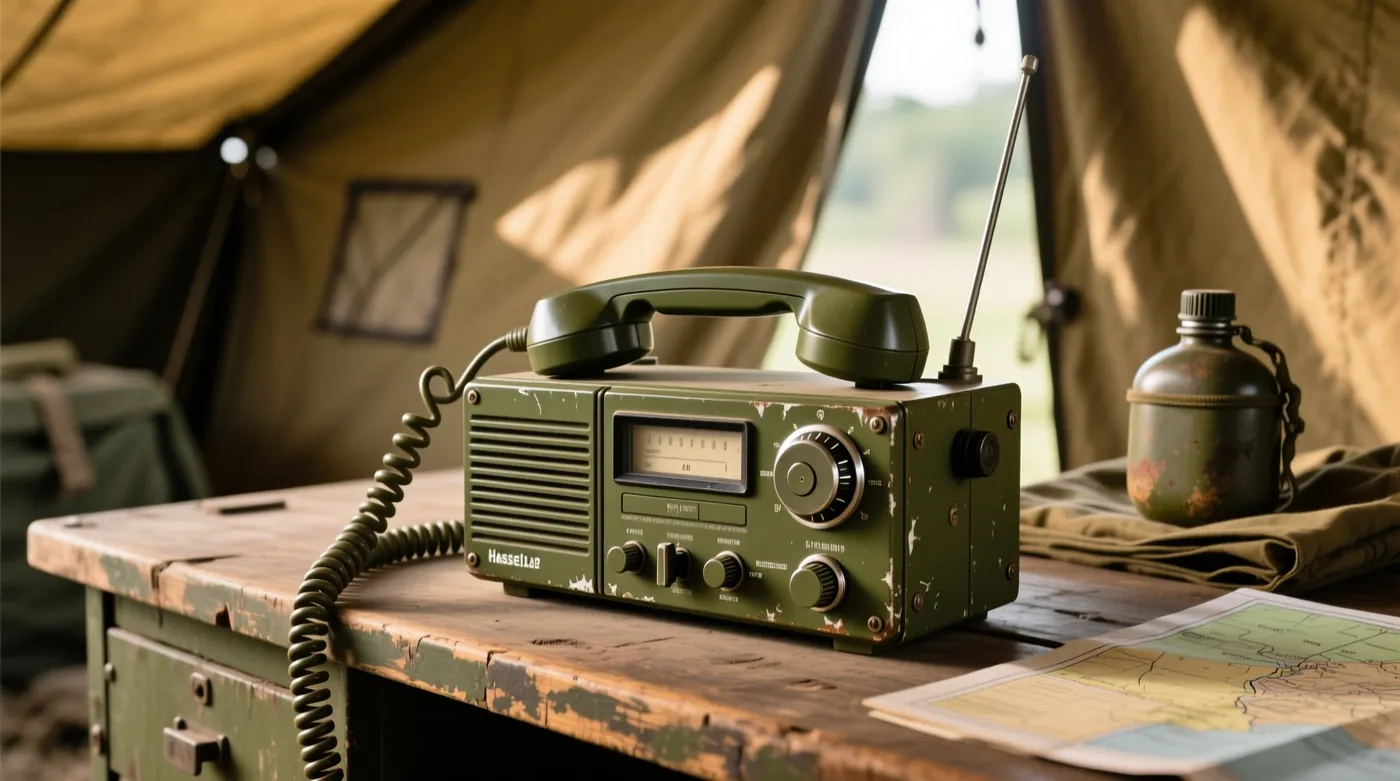
Most strategy games hand you a god's-eye view: the whole map, every unit, every enemy marker. Radio Commander does the opposite. You sit in a command post with a handset, a paper map and a log of voice reports, and you never see the battlefield at all. This article explains what radio-only command means in practice, why it changes the way you make decisions, and what a player has to learn in order to give orders that make sense when the only information arrives through a speaker.
What radio-only command actually means
In a conventional real-time strategy game you look at the field and act on what you see. In Radio Commander the field is hidden. Units are represented on your map as markers, but their real condition, position and surroundings reach you only when a squad keyes the handset and reports. Everything you know is something somebody told you.
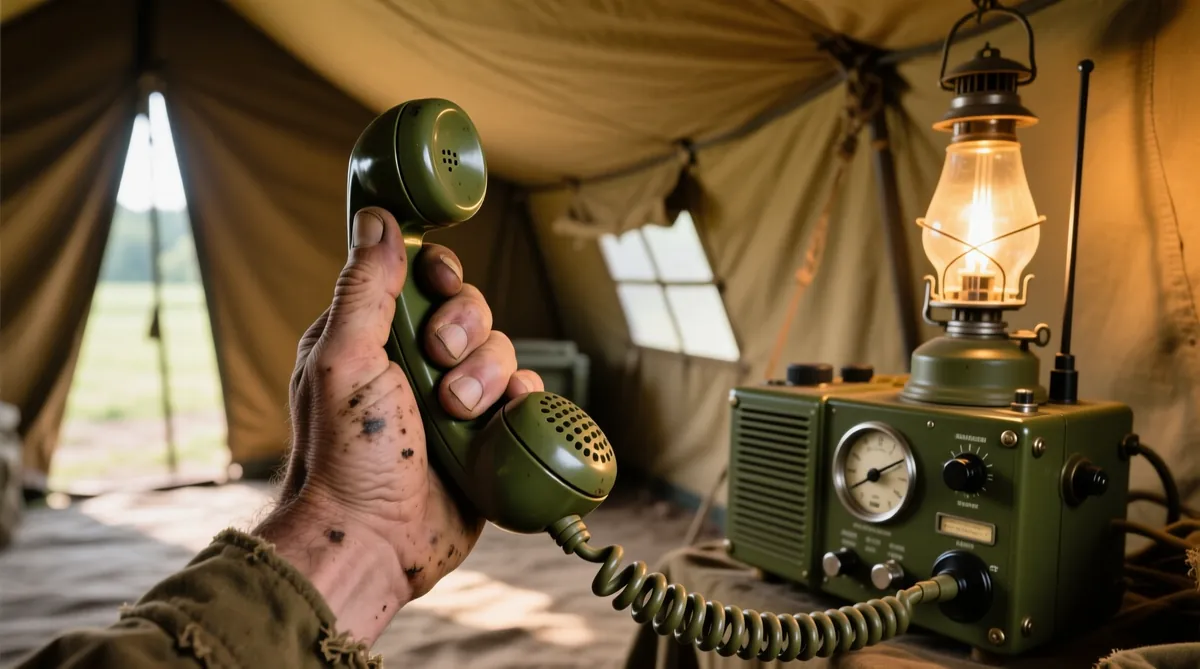
That single design choice rearranges the whole experience. You are not managing a visible board, you are managing a flow of information. The map on the table becomes a working sketch rather than a picture of truth, and the radio log becomes your real instrument of command.
Why removing the map view changes decisions
When you cannot confirm a position with your own eyes, every order carries a question mark. A squad reports its location in grid coordinates, and you have to trust the report, correct it against the terrain, and decide how much weight it deserves. Confidence becomes a resource you spend carefully.
The practical effect is that you start asking different questions. Instead of "where is the best place to attack", you ask "what do I actually know, what am I assuming, and what happens if I am wrong". That shift is the heart of the game.
Reports as your only picture of the field
A report is not a status bar. It is a sentence from a soldier who is tired, under pressure and possibly frightened. The same event can arrive as a calm contact report or as a panicked shout, and the difference matters when you decide whether to reinforce, withdraw or hold.
Reports also arrive out of order. Two units may describe the same firefight from opposite sides, and a third may mention something neither of them noticed. Building a working picture means reconciling several partial accounts rather than reading one authoritative display.
Grid coordinates and reading the terrain
Positions are given as coordinates on the map, which forces you to think in terms of the ground between those numbers. A hill, a river line or a stretch of dense vegetation can decide whether a route is fast or fatal, and none of that is visible as a simple colour on a minimap.
Terrain therefore matters twice over: once as a physical obstacle and once as an obstacle to information. Troops in heavy cover are harder to see and also harder to hear from, so the places that protect a unit are often the places where you understand it least.
Orders, delays and the cost of waiting
An order does not land instantly as an animation. You issue it, the unit acknowledges, and the action unfolds while you wait for the next report. Delay is built into the loop, and a decision that looks correct at the moment you give it may be wrong by the time it is carried out.
That uncertainty pushes you toward habits that feel unnatural for a strategy player: confirming before committing, keeping a reserve, and giving orders that remain sensible even if the situation has shifted slightly by the time they are executed.
What this teaches about command
Radio-only command is a study in working with incomplete information under time pressure. You learn to separate what you have been told from what you have inferred, to weight a report by its source, and to accept that some of your decisions will turn out badly for reasons you could not have known.
A commander in the game who tracks only the markers and ignores the tone, timing and gaps in the traffic will make confident mistakes. A commander who listens carefully to the log, keeps the picture honest and stays willing to hold a unit back tends to keep more of the force alive.
Habits that make radio command work
The following habits come straight out of the design: they are the behaviours the game rewards across a campaign, and they apply to almost every mission you will play.
- Write down or hold in mind the last confirmed position of every unit, not where you hope it is.
- Reconcile conflicting reports before you act on any single one of them.
- Keep a reserve for the moment a report contradicts your plan.
- Read the tone of a message, not just its content, when judging how urgent it is.
- Give orders that still make sense if the unit has already moved a little.
- Confirm a withdrawal or a fire mission rather than assuming it was understood.
None of these habits is about reaction speed. They are about treating information as something you have to earn, one transmission at a time.
Orders, what they do and what to weigh
| Order | What it does | What to weigh first |
|---|---|---|
| Move | Sends a unit to a new position | Terrain on the route and how stale the report is |
| Engage | Opens fire on a reported contact | Confidence in the enemy position and the unit's ammo |
| Barrage | Brings indirect fire onto an area | How close friendly units are to the target |
| Retreat | Pulls a unit back out of contact | Whether the route back is covered or open |
| Report | Requests a fresh situation update | The time you spend waiting instead of acting |
Radio-only command is not a limitation bolted onto a normal strategy game; it is the point of the game. Once you accept that your picture of the field is always a little out of date, the whole experience becomes about judgement rather than clicks, and the reports crackling over the handset turn into the only map that matters.